The chemical reaction
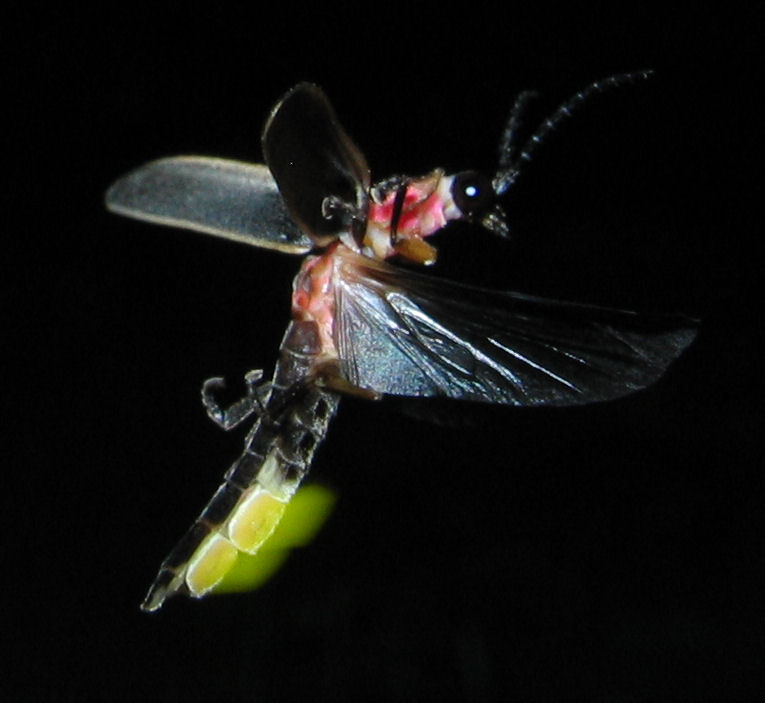
Firefly light comes from a reaction between a small molecule called luciferin and an enzyme called luciferase. The words come from the Latin lucifer, “light-bringer”, and are general names: many unrelated glowing organisms, from marine bacteria to jellyfish and fungi, have their own luciferins and luciferases. The firefly versions are specific to beetles.
In simplified form, the steps are these:
- Inside the light-producing cells, luciferin is combined with adenosine triphosphate (ATP), the cell's universal energy currency, and magnesium ions, with luciferase speeding the process up.
- This yields an energised intermediate, which then reacts with oxygen.
- The product, oxyluciferin, is created in an excited state. As it relaxes to its normal state it releases the extra energy as a photon of visible light.
Because the reaction needs oxygen, a firefly controls its flash by controlling the oxygen supply. The light organ is richly supplied with fine air tubes (tracheae), and the nervous system can open or restrict the flow of oxygen to the light-emitting cells. Current research also points to a role for nitric oxide in switching the flash on and off. The precise millisecond timing seen in flash patterns is therefore a feat of nervous control, not of chemistry alone.
Why it is “cold light”
An incandescent bulb wastes most of its energy as heat: only a few per cent emerges as light. A firefly's reaction is remarkably efficient, with a large fraction of the chemical energy released as light and very little as heat. That is why the light is called cold light, and why a firefly can glow without burning itself. Fireflies also emit essentially no infrared or ultraviolet radiation; the light is concentrated in a narrow band of the visible spectrum, usually yellow-green to orange.
The colour is set by the shape of the luciferase protein, so small changes in the enzyme can shift the glow from green to yellow or orange. Because of the reaction's efficiency, firefly luciferase has also become a standard tool in medical and biological laboratories, where it is used to detect ATP and to make cells report on their own activity.
What the light is for
Finding a mate
In many species the flash is a courtship code. Males patrol, flashing a species-specific pattern; a receptive female answers from the ground or from a perch after a precise delay. The male then approaches, flashing again, and the pair finds each other in the dark. Because the pattern and the delay are specific, a female answers only males of her own species.
A warning colour for larvae
Eggs, larvae and pupae of many species glow faintly, long before they have any need to find a partner. This is thought to be the ancestral function of the light: an aposematic, or warning, signal. Fireflies make bitter defensive compounds called lucibufagins, steroid-like chemicals that are toxic to many predators, and a glowing larva advertises the fact. Some birds, lizards and frogs learn to avoid glowing prey, and some captive animals that eat fireflies have become ill.
Other uses
A number of species have lost flashing altogether. In these the adults are active by day and find each other using scent (pheromones) instead. This shows that the lamp is optional: the family evolved the light early, but several lineages have given it up.
Species differ in their flash patterns
The pattern is what an observer notices first, and experts can identify many species just by watching. A pattern has several variables: the number of flashes, their length, the interval between them, the flight path of the male (rising, level, swooping), the colour, and the female's response delay.
| Group | Typical pattern |
|---|---|
| Photinus pyralis (common eastern firefly) | The male flies upward in a J-shaped swoop, flashing once about every five to ten seconds; the female answers after a short pause. |
| Photuris | Species vary, but the females can imitate the replies of other species' females (see the next page). |
| Pteroptyx (Asian mangroves) | Thousands of males flash in unison, producing waves of synchronised light. |
| Lampyris noctiluca (glow-worm) | The wingless female glows steadily, rather than flashing, to attract flying males. |
Temperature affects timing: a flash pattern slows down on cool nights because the firefly's nervous system, like all cold-blooded animals', works more slowly. Observers who record patterns therefore note the air temperature as well.