Well-known groups
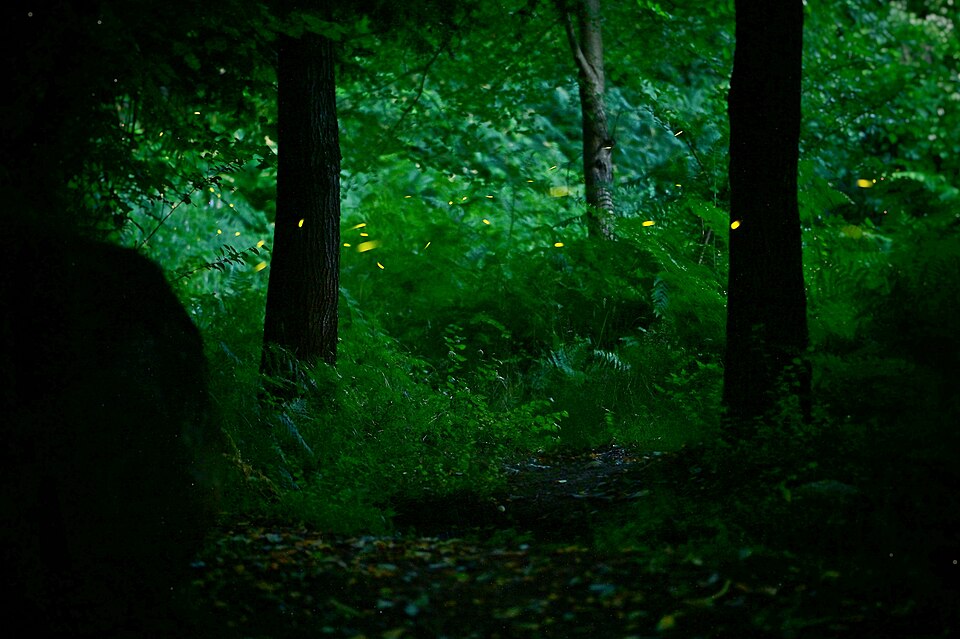
With over 2,000 species, a complete list is out of the question. The groups below are among the best known and show the range of the family.
- Photinus — the “lightning bugs”
- A large genus of North America, with dozens of species, among them the common eastern firefly Photinus pyralis. Adults are found in meadows, lawns, forest edges and damp grassland, and they fly in the early evening, usually from late spring to midsummer. Each species has its own flash pattern.
- Photuris — the “femmes fatales”
- A genus that has a remarkable habit. Females of many Photuris species imitate the answering flashes of female Photinus. A male Photinus that comes to investigate is caught and eaten. By eating them, the Photuris female gains the defensive lucibufagins that she cannot make herself and so gains protection against spiders and other predators. Photuris is larger than Photinus and, for that reason, can be told apart by size.
- Lampyris noctiluca — the common glow-worm
- The best-known firefly of Europe. The wingless, larva-like female climbs a grass stem on summer nights and glows a steady greenish light to attract the flying males, which glow only faintly. It lives in grassland, hedgerows, woodland edges, railway embankments and gardens, mostly on calcareous or damp ground, and is active in June and July.
- Aquatica — the water fireflies
- Unusually, the larvae of these fireflies live in water. In Japan the species Aquatica lateralis (the Heike-botaru) has aquatic larvae which breathe through gills and feed on small freshwater snails in clean, slow streams and ditches. When ready, the larva climbs out onto the bank and burrows into damp soil to pupate. The adult fireflies emerge in early summer and glow in the evening. Clean water and unlined, vegetated banks are essential.
- Pteroptyx — the fireflies of Asian mangroves
- Along tidal rivers in Malaysia, Thailand, Indonesia and neighbouring countries, males of species such as Pteroptyx malaccae and Pteroptyx tener gather in the thousands in a few favoured trees, typically berembang (Sonneratia caseolaris) mangroves, and flash in synchrony. The effect is of whole trees pulsing with light, and it has become a significant draw for visitors. The larvae of these species live in the mud of the riverbank.
- Phausis reticulata — the blue ghost
- A small firefly of the Appalachian forests of eastern North America. Males give off a steady pale blue-green glow while flying low over the leaf litter in late spring, rather than flashing.
- Lucidota and other day-flyers
- Some fireflies, such as members of the genus Lucidota, are sometimes called “dark” fireflies, because as adults they hardly glow, if at all. They fly by day and rely on pheromones to find mates. Their larvae still glow.
Habitats
Fireflies are most often linked with warm, humid places, but they are found from subtropical rainforest to temperate meadows. What nearly all species share is a need for moisture and for undisturbed ground, because the larvae live there for most of their lives. Typical habitats include:
- damp meadows and long grass;
- woodland edges, leaf litter and rotting wood;
- stream banks, ponds, marshes and rice paddies;
- mangrove and riverside forests in the tropics;
- old, unmown corners of gardens and parks.
When they fly
The adult season depends on the species and the climate. In temperate regions, most flying fireflies are on the wing for a few weeks between late spring and late summer; in the tropics, some species are active for much of the year. Within a night, each species has its favoured time: some start at dusk, others wait until it is fully dark. Warm, still, humid nights, without bright moonlight, bring the best displays.
Larvae and pupae
A firefly spends most of its life as a larva. Females lay eggs, often one by one, in moist soil, moss or leaf litter. The eggs hatch in a few weeks, and the larvae — dark, flattened, segmented and sometimes with pale glowing spots on the underside — hunt at night for snails, slugs and earthworms. They inject a paralysing, digestive fluid with hollow, sickle-shaped jaws and then suck up the dissolved meal. Many species spend one to two years as larvae, overwintering underground or under bark.
When fully grown, the larva forms a small chamber in the soil or under moss, and pupates there. The pupa, which may glow, remains for one to a few weeks. The adult then emerges and lives for a short time, generally concerned only with finding a mate and laying eggs.